
|
Ethno::log |
|
... Previous page
Anthropologists studying corporate informatics
... Link (0 comments) ... Comment Dept. of job opportunities, zephyrin, April 8, 2004 at 11:58:02 AM CEST International Youth Link Foundation Some students seem to have made positive experiences with the International Youth Link Foundation. Especially with an exchange program concerning Ghana. ... Link (1 comment) ... Comment Dept. of , vernant, March 30, 2004 at 5:38:44 PM CEST Funding for EASA, September in Vienna The Annual Conference of the European Associacion of Social Anthropologists takes place in Septmber in Vienna. There are still grants for accommodation and participation available ... Link (2 comments) ... Comment Dept. of ethnologica, kerleone, March 30, 2004 at 10:46:50 AM CEST Eco Tourism in Surinam Süddeutsche Zeitung reports (in german) about a little village in Surinam. While some residents would like to bring tourism to Kwamalasamu, others don't like the idea. ... Link (0 comments) ... Comment Dept. of Publications, zephyrin, March 29, 2004 at 1:47:43 PM CEST Rwanda's Genocide Linda Melvern's (1)Linda Melvern is an Honorary Fellow of the University of Wales, Aberystwyth, Department of International Politics. An investigative journalist, she previously worked on the Sunday Times in London, including as a member of their award-winning Insight Team. Since leaving the paper to write her first book, she has written widely for the British press. Her book on the fifty-year history of the UN was turned into a major television series, UN Blues, for Channel Four television. She writes for British newspapers and magazines and lectures and broadcasts on international issues. She has been researching the circumstances of the genocide in Rwanda for nearly eight years and her account of the genocide, A People Betrayed. The Role of the West in Rwanda?s Genocide was published in September 2000 by Zed Books. It was chosen book of the year in The Observer by Geoffrey Robertson, QC and she was the runner-up in the 2001 Martha Gellhorn journalism award. The book is in its third impression and an updated and revised edition will be published in 2003. via Anthropology Matters book A People Betrayed: The Role of the West in Rwanda's Genocide (2)MELVERN, LINDA. 2000. A People Betrayed: The Role of the West in Rwanda's Genocide, London: Zed Books. [ISBN: 185649831X] is now available in german (3)MELVERN, LINDA. 2004. Ruanda: Der Völkermord und die Beteiligung der westlichen Welt. München, Kreuzlingen: Hugendubel, Diederichs. [ISBN: 37205248668]. "The subject of A People Betrayed, by the British investigative journalist Linda Melvern, is the catastrophe that descended on the tiny Central African nation of Rwanda in 1994. Historians and analysts of these events have long linked western policies to the "genocidal frenzy" that gripped Rwanda for twelve unforgettable weeks -- a period during which the rate of mass killing exceeded that of the Jewish holocaust by roughly fivefold." Read the full review by Adam Jones and don't miss the discussion Representing Rwanda: Questions and Challenges at Anthropology Matters. ... Link (0 comments) ... Comment Dept. of localica, zephyrin, March 26, 2004 at 3:39:32 PM CET SouthEast-Asia in Munich Aus der Veranstaltungsreihe "Unter dem Monsun: Kultureller und politischer Wandel in Süd- und Südostasien" Donnerstag 25. März 2004, 18 Uhr Laos - Stachus - Hanoi Mit der Kamera auf der Suche nach süd(ost)asiatischem Leben in München [read more]AUSSTELLUNGSERÖFFNUNG DES FOTO- WORKSHOPS FÜR JUGENDLICHE mit Nguyen Tan Loc und Andrea Huber 19 Jugendliche im Alter von 12 bis 18 Jahren ? manche davon selbst mit asiatischen Wurzeln - hatten sich auf Suche nach süd(ost)asiatischem Leben in München begeben. Ob die boomenden indischen Klänge der Clubszene, Bollywoodfilme, die florierenden Asian Food Läden, buddhistische Zentren, binationale Ehen oder die Situation der Asylbewerber ? knapp 6.000 Menschen süd- und südostasiatischer Herkunft leben in München. Sie kommen aus Vietnam, Thailand, Laos, Kambodscha, Indien, Bangladesch, Sri Lanka und anderen Län-dern und gestalten das Leben in unserer Stadt durch ihren kulturellen Hintergrund, ihre Ar-beit oder ihre Religion mit. Die Spannung des Fotoprojektes lag nicht zuletzt darin, dass die Biographien der Teilnehme-rInnen und der Leitung in den Workshop einflossen. So entstanden aus einer lebendigen interkulturellen Begegnung beeindruckende künstlerische Ergebnisse. Die bei dem Workshop entstandenen Fotos der TeilnehmerInnen werden bis zum 8. April 2004 (Mo-Fr, 15-18 Uhr) in der Färberei, Claude-Lorrain-Str. 25 Rgb., ausgestellt. Nguyen Tan Loc wurde 1971 in Vietnam geboren und lebt seit 1979 in München. Er absol-vierte die Staatliche Fachakademie für Fotodesign in München sowie ein postgraduiertes Studium für Fotojournalismus am London College of Printing. Projekte führten ihn nach Eng-land, Italien und Vietnam. Andrea Huber, Jahrgang 1969, ist Absolventin der Staatlichen Fachakademie für Fotode-sign in München und hat im Rahmen ihrer Arbeit zahlreiche Länder bereist, so Tanzania, Südafrika, Rumänien, Australien, Vietnam. 1997 erhielt sie den Jugendfilmpreis München, und im Jahr 2002 wurde eines ihrer Projekte mit dem deutschen Jugendfotopreis ausge-zeichnet. Ort: Färberei, Claude-Lorrain-Str. 25, Rgb., 81543 München Ausstellungsdauer: bis 8. April, Mo ? Fr, 15 ? 18 Uhr Info: Andrea Huber, Tel 0179 ? 460 47 15 Kulturreferat, Tel. 233 - 21244 Veranstalter: Kulturreferat; Stelle für interkulturelle Arbeit der Landeshauptstadt München; Arbeitsstelle EineWelt im Pädagogischen Institut des Schul- und Kultusreferates, Kreisjugendring München ... Link (1 comment) ... Comment Dept. of ethnologica, kerleone, March 25, 2004 at 12:40:33 PM CET 4000 year old Selk'nam found Anthropologists and geologists from the Austral Scientific Research Centre have discovered the body of an adult who lived on the north coast of Tierra del Fuego (Argentina) 4,000 years ago. [more...] 'The body is very well preserved, totally articulate, with complete denture,' said anthropologist Monica Saleme. The skeleton, found beneath a 3,900-year-old 'conchero' (shell pit), may be the oldest so far discovered in the region. Shell middens of this type are quite common and indicate the sites of temporary habitations where hunter-gatherers would settle for several months at a time to feed on molluscs and other sea foods, and take time to make implements. The dating corresponds to the time of the world's highest sea levels - the burial is now almost 3,000 meters from the present coastline. The 1.7m body was buried in the foetal position on its right side, with the left hand under the head and knees close to the chest. Tools and utensils dating back 12,600 years and thought to have been produced by the selk-nam ona tribe have been found in Tierra del Fuego, but no human remains from so early a date. 'We can't say if [the skeleton] belongs to a selk-nam, although they inhabited the area,' says Saleme. The remains have now been taken to the main ASRC Cadic laboratory for further examination and DNA tests. Researchers are interested in the different migrations into Tierra del Fuego during the Holocene and the DNA tests will determine the body's migratory origin. Source: MercoPress (17 March 2004) Via Sauseschritt ... Link (0 comments) ... Comment Dept. of thoughts, kerleone, March 25, 2004 at 10:38:03 AM CET Satanic Mills: Against Pure Capitalism Vernant, our fellow student currently for a year at the London School of Economics, provided us a thoughtful article about capitalism, and why he believes that we should in future accept it partly, and partly not.Satanic Mills
To call for a 21th century to be the era of "pure capitalism" is not only insipid, but also immoral. Proud capitalists abound at the LSE in these days: What is most obscene about that is that they try to bring two apparently very odd things together: an economic system which subsumes everything beneath its basic imperative of making profit, and morality. Those who are sceptical about capitalism are depicted as dumb defenders of state planning. To the contrary, only capitalism should be properly moral, according to these staunch believers. Because only in a capitalist system the individual is free - free to think, free to do, and free to exploit, one might add. To exploit his peers, the other free individuals, and nature, corresponding to the free decisions he has taken in his mind. What is missing in those not very penetrative accounts is a closer look at what morality means: [...read more]for fatuous defenders of capitalism it is nothing more than individual freedom. But what about the others? Isn?t it the case that morality is really about relationships between people? What are we on if somebody abuses the freedom he enjoys only for his own piggishness? Let?s look what other reasons there might be to claim that capitalism is a moral thing: It is said to be against racism. Because racism doesn?t pay nowadays. If it would pay, capitalists would have no problem being racists whatsoever. Take Henry Ford, a respectable capitalist in my view. He was known for his anti-Semitism. But it didn?t impede him earning a fortune and changing an entire society. In our time, no major capitalist could take publicly a racist position, and continue to amass money. So he will deliberately avoid to discriminate too bluntly - not because of any morals, but because of grabby self-interest. Or take sexism, for that matter: female producers and consumers are rather ok for capitalists. Commodification of the female body too. Far from being moral, capitalism has continuously torn apart and destroyed every moral idea, as soon as it was incommensurate with making money. What strikes me most is that proud capitalists often mention the poor, whose poverty is seemingly caused by their own lack of talents. They depend on the rich, but any kind of redistribution is restoring communist spectres. Which is a contradiction in itself: The poor are reliant on the wealthy, but the fortune of the latter should be protected. Where should then any sources for the poor come from? What else should help except for redistribution? Our capitalists only want to assure that no money is stolen from the wealthy - they are the most productive, after all. The poor can remain in their miserable condition, this shall be the most appropriate incentive for them to struggle for progress. Additionally, when they are continuously watching others consuming champagne, diamonds and supermodels, they should have even more stimulus to become more productive. That conspicuous consumption might play a role in perpetuating outrageous inequalities is not mentioned. Gigantic amounts of money could be used for redistribution, instead of dissipation. Yes, this should appeal to a very basic instinct: envy. But I also bet on something which is lacking in the moral philosophy of pure capitalism: social justice. I would argue, however, that capitalism as an encompassing system has a morality, namely a split one. This morality consists of two opposed ideologies: total self-interest and the total gift. Some are self-interested, rational maximizers of their utility - some even unapologetically so. Others give free and care for their neighbours, moved by compassion. But actually most of us do both, and try to reconcile both. The difference is that "pure" capitalists submit totally to their self-interest, and give charities only when it fancies them. Whereas others would find it more reasonable to have redistribution institutionalized. Up to the present capitalists have been presented frequently as greedy and avaricious. And rightly so. A world reigned by pure capitalism is a quite gloomy and morbid illusion. In the absense of state interventions, the capitalist market becomes a "Satanic Mill," in Karl Polanyi?s words, that erodes the social foundations of its own existence. Neither can one deny the efficiency of markets in certain respects. But none of the extremes is good. The middle way would be the better: to use capitalism and its effectiveness, and combine it with ethical commitment and thus, redistribution. ... Link (2 comments) ... Comment Dept. of , vernant, March 25, 2004 at 2:12:59 AM CET German anthropology during the Third Reich Andre Gingrich, professor in Vienna, delivered a paper at the LSE's research seminar last week on German anthropologists under Hitler and their interaction with british colleagues. After the marginalization of several other schools of thought, like Materialism, Culture Morphology, and 'theological' culture circle theory, two schools remained in German anthropology, and were compatible with Nazi ideology, according to Gingrich: Functionalism (Thurnwald, Muehlmann, Fürer-Haimendort, Wagner) and 'secular' culture history (Krickeberg, Reche - and: Hermann Baumann. The founder of Munich's institute for ethnology did not figure prominently in the presentation, as Gingrich focused on the biographies of Fürer-Haimendort and Wagner, who are indeed very interesting figures. But it was for the first time I heard about the potential problems with Baumann's major work "Die Völker und Kulturen Afrikas". Gingrich's paper is going to be published in a book edited by him and Sydel Silverman. Here is an Interview with Gingrich on Anthropology and Colonialism, where he tells us that Talal Asad's father was a Wiener called Leo Weiss. ... Link (1 comment) ... Comment Dept. of Publications, kerleone, March 24, 2004 at 12:28:08 AM CET Cooper: Bibliography of Tierra del Fuego  Well, let's don't talk about open research, let's do it. Again I scanned a book for my own use which is most likely without copyright now. This time it's John M. Coopers brilliant bibliography from 1917 about all kinds of works about tierra del fuego, containing useful short comments about all of the travelers, scientist and missionaries (quite a few!). Half of the book is a also useful systematic but basic ethnography thrown together by single observations of various autors. At there's a map too.
Update: It's on a new server. Thanks korikori!
Well, let's don't talk about open research, let's do it. Again I scanned a book for my own use which is most likely without copyright now. This time it's John M. Coopers brilliant bibliography from 1917 about all kinds of works about tierra del fuego, containing useful short comments about all of the travelers, scientist and missionaries (quite a few!). Half of the book is a also useful systematic but basic ethnography thrown together by single observations of various autors. At there's a map too.
Update: It's on a new server. Thanks korikori!
... Link (0 comments) ... Comment Dept. of tools, kerleone, March 22, 2004 at 10:55:53 PM CET Using diacritic fonts In anthropology we have to use very often linguistic symbols to describe foreign words or names. I am not an expert in this, but there seem to be different ways of transcription.
One of it is the International Phonetic Alphabet (IPA).
Some of us, like me, haven't got any idea of phonetics, but would like to painlessly transfer the "hieroglyphics" from our source texts into our own articles, so that at least no information gets lost.
But it doesn't seem to be an easy task. The IPA lists some fonts for use with textprocessors like Word or StarOffice on Windows or Mac OS. A lot of fonts are able to write IPA-glyphs. A well known unicode font is Arial Unicode, which is distributed with Microsoft Office. Another great one is Gentium a font explicitly aimed for the use in the scientific community with multilingual requirements.
I tried them all, but soon was diappointed: It seems, that all those unicode fonts contain the IPA characters, but some of them like the breve under a letter are only avaliable as "combined diacritical sign". This means, you have to type an normal character like "i", and then select the breve from the table with symbols. This is the result:
Ask in the comments if you have trouble installing the font or inserting the symbols with your textprocessor. ... Link (0 comments) ... Comment Dept. of thoughts, kerleone, March 16, 2004 at 10:41:50 AM CET Tenth planet (?) named after Inuit Goddess NASA-funded researchers have discovered the most distant object orbiting Earth's sun and named it after Sedna, Inuit Goddess of the Ocean. The object is a mysterious planet-like body three times farther from Earth than Pluto, reports Nasa. In fact, its really cold there (-240 Celsius). If its really a planet, what is already discussed, then it is a fair move from the scientists to use a god name from outside european mythology. In german, read also Spiegel. Via ITW ... Link (3 comments) ... Comment ... Next page
|
The finest stuff from ethnology social/cultural anthropology and cyberanthropology. Collected with ceaseless endeavour by students and staff of the Institut für Ethnologie in München/Germany and countless others.
... about this website Online for 9121 days Last modified: 11/29/22, 8:56 PM Search
Browse by Category
Status
Youre not logged in ... Login
Menu
Calendar
Recent updates
Schade Oh, so bad! The
oldest anthropology blog is closing :(( It seems the whole...
by iglu01 (1/4/20, 4:05 PM)
-- Closed -- I think
it's time to close the weblog, it's already sleeping since...
by kerleone (12/29/19, 1:54 PM)
Stellenausschreibung des Max-Planck-Instituts für ethnologische
Forschung. Bewerbungsfrist: 15.02.2017 Das Max-Planck-Institut für ethnologische Forschung sucht Doktoranden/Doktorandinnen...
by HatEl (1/31/17, 9:11 AM)
Ethnosymposium in Halle (Saale): Call
for Contribution – 14.-17. Mai 2015 Call for Contribution –...
by normanschraepel (2/9/15, 3:35 PM)
Bruno Latour: Kosmokoloss. Eine Tragikomödie
über das Klima Der Hörspiel Pool von Bayern 2 hat...
by pietzler (11/21/14, 3:23 PM)
Send us suggestions
   |
||||||||||||||||||||||||||||||||||||||||||||||||||||||||
 Bryan Alexander writes at
 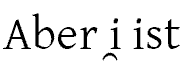 Because the breve is put under the letter "on the fly", the position is only more or less under the letter. Looks definitly ugly.
But after a lot of searching and some help of other
Because the breve is put under the letter "on the fly", the position is only more or less under the letter. Looks definitly ugly.
But after a lot of searching and some help of other 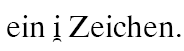 Well, this looks a lot better, no?
The ready-made IPA-Glyphs are in the "private area" of the font, which is named diferrently on the different wordprocessing programs. Anyway, its the area following to the bopomofo script so you may easy find it.
Update: Please note that there could be troubles by using different fonts in one paragraph. But Microsoft Word and Star Office/Open Office both have solutions for this problem. I can only explain in german: You have to choose "Format – Absatz – bei Zeilenabstand "genau" in Word or to activate "Registerhaltigkeit" in Open/Star Office (both in the Absatzeinstellung and the Seiteneinstellung).
Well, this looks a lot better, no?
The ready-made IPA-Glyphs are in the "private area" of the font, which is named diferrently on the different wordprocessing programs. Anyway, its the area following to the bopomofo script so you may easy find it.
Update: Please note that there could be troubles by using different fonts in one paragraph. But Microsoft Word and Star Office/Open Office both have solutions for this problem. I can only explain in german: You have to choose "Format – Absatz – bei Zeilenabstand "genau" in Word or to activate "Registerhaltigkeit" in Open/Star Office (both in the Absatzeinstellung and the Seiteneinstellung).